American warships in the region serve dual purpose
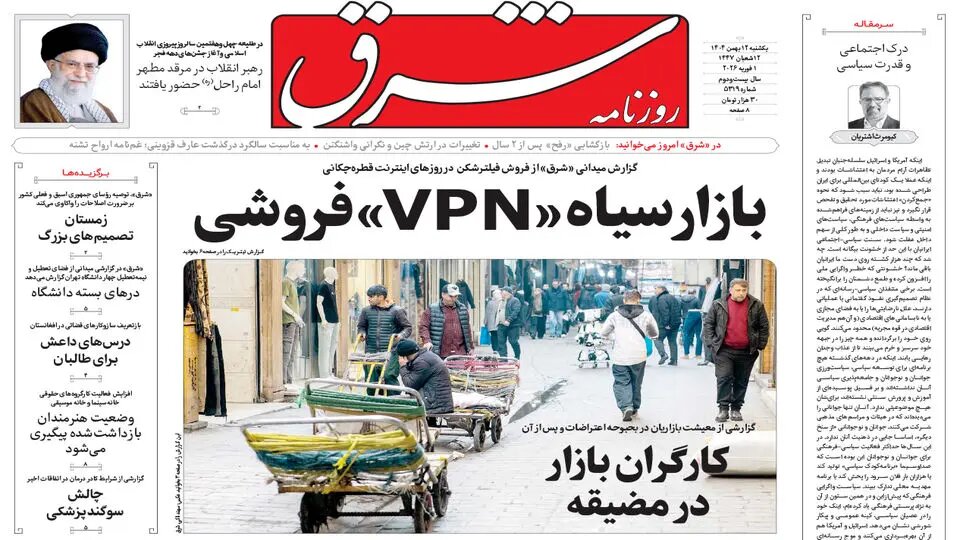
Shargh spoke with Rahman Ghahremanpour, an international affairs analyst, to examine recent developments and the objectives of the various actors now shaping the region. According to him, the deployment of U.S. naval forces in the Persian Gulf is intended both to facilitate negotiations and to prepare for a possible confrontation with Iran.
Within the framework of the U.S. president’s coercive diplomacy, these two approaches are not contradictory; they actually reinforce one another. As seen during the 12-day war, Donald Trump typically begins by calling for negotiations and a diplomatic agreement, and if such efforts fail, he turns to military action. Ghahremanpour believes Trump aims to first present Iran with a diplomatic proposal containing conditions that Tehran is unlikely to accept. He would then announce to the international community that Iran refused to cooperate, thereby justifying military measures. In any case, a diplomatic agreement is still possible, though extremely difficult. Achieving it would require the United States—and then Iran—to revise their policies and positions.
Sobh-e-No: Outside the power equation
In an article, Sobh-e-No discussed Europe’s motivation for designating Iran’s Islamic Revolution Guard Corps as a terrorist organization. According to the paper, the European Union added the IRGC to its terrorism list in an attempt to win the approval of the U.S. president, resolve trans-Atlantic disputes, and dissuade him from pursuing the idea of occupying Greenland. The article argues that Europe has long been pushed out of global geopolitical equations, a reality that has become even more evident in recent years as the continent has failed to end the war in Ukraine. Now, Europe’s display of anti-Iran posturing to please Trump clearly shows that it has turned into a scarecrow for the United States and Israel, lacking any independent will or decision-making power. It concludes that hostile European actions will not go unanswered by the Islamic Republic. Reciprocal measures—especially in security and military arenas and through cooperation with Moscow and Beijing—should impose costs and consequences on adversarial states, ultimately leading the ‘terrorist European Union’ to regret its decisions.
Khorasan: When diplomacy must work
Khorasan, in an explanation, examined Araghchi’s trip to Turkey and wrote that at a time when U.S. verbal and military threats have reached their peak, West Asia once again stands on the brink of a full-scale crisis. On one hand, Donald Trump’s provocative statements have intensified an atmosphere of psychological warfare; on the other, U.S. military movements—through the deployment of warships and an overt military posture in the region—have pushed these threats from the verbal level toward operational reality. Yet at precisely this moment, Turkey offers to mediate, and Abbas Araghchi heads to Ankara. In today’s tense environment, one common mistake is reducing diplomacy to ‘retreat.’ Experience has shown that in critical moments, a country’s most important asset is not merely military power but public trust. Public opinion supports difficult decisions only when it is convinced that every reasonable path to avoid war has been exhausted. From this perspective, Araghchi’s trip is not an emotional gesture but a calculated effort to preserve that social capital—an attempt to ensure that if the crisis reaches an irreversible stage, responsibility clearly falls on the side that abandoned diplomacy.
Donya-e Eqtesad: Negotiation is necessary
According to Donya-e Eqtesad, the fundamental mistake from the beginning was a failure to consider Trump’s psychology. The entire world understands that he wants to be at the center of attention and to claim full credit for resolving any issue, and under such conditions, he is willing to show flexibility. It has now become clear that efforts through Araghchi and Witkoff have not produced results. Today, conventional diplomatic tactics and familiar maneuvering cannot shift Trump from his current position. A change in domestic and foreign policy approaches has become unavoidable. If our officials prefer diplomacy over war, they must also accept its requirements—especially negotiation. Lifting sanctions is essential, and therefore achievable only through negotiation. Moreover, the real and final positions of the United States can only be understood inside the negotiation room, particularly in the final stages after bargaining. No government links its decisions on the other side’s public rhetoric. Likewise, no responsible government abandons negotiations because of vague, subjective, or undefined concepts such as mutual respect, fairness, or equality. Indirect negotiations through intermediaries and insisting that talks be limited to a single issue are highly unusual and unorthodox in diplomacy.
Leave a Comment